

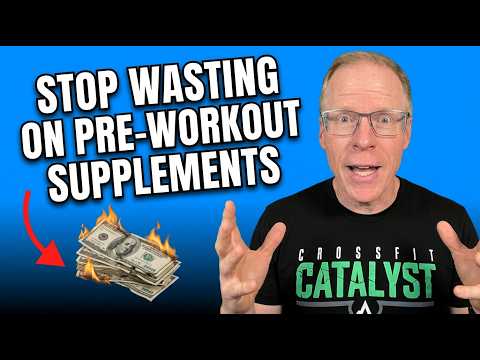
The pre-workout supplement industry is worth roughly fifteen billion dollars globally. Walk into any supplement store and you’ll find hundreds of products with aggressive names, bright packaging, and ingredient lists a mile long.
Here’s what the research says most people actually need before a workout: some carbohydrates, a bit of protein, and for many people, a coffee.
That’s not the complete story — timing matters, training intensity matters, and there are real differences between training fasted and fuelled. But the gap between what the industry sells and what the research supports is large. Here’s what the evidence actually says.
Food First: The Foundation
Before discussing any supplement, understand what food actually does before training — because for most people, the right food at the right time will outperform any product.
Your body fuels exercise primarily from glycogen stored in muscles and liver, and from fat. For low-intensity work (Zone 1-2), your body can run largely on fat even without recent food. For moderate to high intensity — strength training, intervals, conditioning — you need glycogen. Low glycogen at the start of a hard session means compromised performance.
1 to 3 hours before training: A meal or substantial snack combining carbohydrates and protein is the most evidence-supported approach. Carbs top up glycogen. Protein slows digestion slightly for steadier energy and begins supporting muscle protein synthesis before you’ve even lifted a weight. Research consistently shows that carbs plus protein before exercise improves both performance and recovery compared to carbs alone.
Good options: oats with milk and banana, Greek yogurt with fruit, rice with chicken or eggs, whole grain toast with eggs.
30 to 60 minutes before: Keep it light and digestible. Your digestive system can’t handle a full meal without redirecting blood flow to your gut — less available for working muscles. A banana, rice cake with nut butter, or a small protein shake with fruit works well.
One timing warning: Eating high-glycaemic, sugary foods within 15 to 30 minutes of a hard session can trigger reactive hypoglycaemia in some people — an insulin spike that drops blood sugar right as your warmup begins, leaving you flat or light-headed. If you’ve ever eaten something sweet on the way to the gym and felt worse during warmup than before you ate, this is likely why. Give yourself at least 45 to 60 minutes, and choose carbohydrates that digest at a moderate pace.
Morning training fasted: For easy sessions — Zone 1-2 walking, gentle lifting — fasted training is fine. For harder sessions, even a small amount of carbohydrates beforehand improves performance meaningfully. Half a banana or a small bowl of oats is sufficient.
The One Supplement That Actually Works
If you want one supplement with genuinely robust evidence: caffeine.
A meta-analysis of 30 studies found that caffeine supplementation improves performance by reducing perceived exertion and improving endurance. It works by blocking adenosine receptors in the brain — adenosine causes fatigue sensation, and caffeine blocks that signal. Your muscles perform the same. You feel like they’re performing better, which means you push harder and last longer.
The evidence-based dose is 3 to 6 mg per kilogram of bodyweight, taken 30 to 60 minutes before training. For a 70 kg person (about 155 lbs), that’s 210 to 420 mg. A standard 250 ml cup of coffee contains roughly 80 to 100 mg. Two to three cups 45 minutes before training puts most people in the effective range.
Two important caveats. First: habitual daily caffeine users have built tolerance. The performance benefit of pre-workout caffeine is strongest without constant background consumption. Second: commercial pre-workout supplements often contain 200 to 400 mg of caffeine per serving — sometimes more from added guarana or other compounds. A review covering 24 studies found measurable heart rate and blood pressure increases correlating directly with caffeine dose. If you’re new to pre-workouts and experience racing heart, shaking hands, or anxiety during warmup — cut the dose in half immediately.
What About Commercial Pre-Workouts?
Most pre-workout supplements work primarily through caffeine. The other common ingredients have varying evidence and, critically, most don’t produce acute effects in a single session.
Beta-alanine causes the characteristic tingling (paraesthesia) that many interpret as the supplement working. It is working — but it builds carnosine in muscles over weeks of consistent daily use. The tingling is a benign nerve effect, not a performance signal.
Creatine is genuinely effective for strength and power — but through daily saturation over days and weeks, not as an acute pre-workout dose. Taking it right before a session adds nothing beyond what consistent daily use provides.
Citrulline has decent evidence for blood flow and pump during training, but again, effects build with consistency.
If a pre-workout is making you train harder, it’s almost certainly the caffeine. You can get the same dose from two cups of coffee for a fraction of the cost, with dosage you can actually verify, without proprietary blends hiding individual amounts.
The Simple Framework
Training 1-2 hours from now: Carbs and protein meal or snack. Oats, Greek yogurt, eggs on toast.
Training in 30-45 minutes: Light and fast-digesting. Banana, rice cake, small shake.
Training fasted in the morning: Fine for easy sessions. For hard sessions, eat something small.
Want a supplement boost: Two cups of coffee 45 minutes before. Evidence-backed, cheap, controllable.
Want to use a commercial pre-workout: Find one where caffeine is clearly dosed, not hidden. Start at half a serving.
Ready to build a nutrition plan that works around your training schedule? Book your free No-Sweat Intro at Catalyst.
👉 Book your free No-Sweat Intro
Coach Chris Cooper is the owner of Catalyst Fitness in Sault Ste. Marie, Ontario. The Catalyst podcast releases new episodes weekly at catalystgym.com/blog.